How to Lose the Civil War by Bill Fawcett
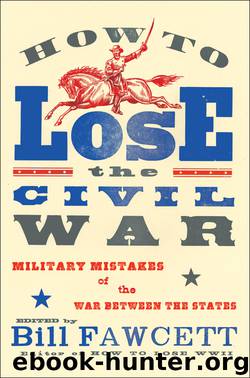
Author:Bill Fawcett
Language: eng
Format: epub
Publisher: HarperCollins
Published: 2011-03-31T16:00:00+00:00
Chapter 19
Confederate Command Failure
July 1, 1863: The First Evening at Gettysburg
Mark Acres
In the musical play 1776, the John Adams character sings about the Continental Congress, “Piddle, twiddle, and resolve, not one damned thing do we solve.” His words, an apt description of many congresses through the ages, also describe the activities of the Confederate high command in the late afternoon and evening of the first day of the Battle of Gettysburg.
After a series of initial reverses, the Confederate III Corps of Lieutenant General A. P. Hill, striking from the west, and the Confederate II Corps of Lieutenant General Richard S. Ewell, striking from the north, had driven the Union forces from the ridges and fields west and north Gettysburg. By 4 P.M. two Union Corps, the I and XI, were in full retreat toward Cemetery Hill just south of the town. A good portion of the XI Corps units panicked and routed when a blunder by Major General Francis Barlow exposed the right flank of his division (and the entire Union line) to a flanking attack by Jubal Early’s Rebel division. A desperate battle against Major General Henry Heth’s and Major General William Dorsey Pender’s divisions of Hill’s corps on McPherson and Seminary Ridges, and against Major General Robert E. Rodes’s division of Ewell’s corps on Oak Hill, left the Union I Corps shredded, although it managed to retreat in good order. As the Union troops streamed in disarray, and some in panic, toward Cemetery Hill, Confederate General Robert E. Lee watched from Seminary Ridge. Lee immediately saw the necessity of occupying Cemetery Hill, and observed that it would be “only necessary to push those people” to drive them from the heights. Lee sent Colonel Walter Taylor to Ewell with word that he should go ahead and “take that hill, if practicable.”
Lee’s order started an ineffective discussion that began that afternoon, grew into a firestorm of controversy after the battle, and continues to this day. The sequence of events that ensued is a case study in the difficulty of communication and coordination on the battlefield in the Civil War. One of the Confederates’ two best chances to claim victory at Gettysburg evaporated in the ensuing stream of piddle, twiddle, and hot air. While taking Cemetery Hill that afternoon or evening would probably have been difficult, perhaps impossible, the opportunity to seize Culp’s Hill, the higher eminence just east of Cemetery Hill and the key to the Union right flank, was lost.
After the battle, many Confederates found it convenient to blame Ewell for the failure to drive straight on up Cemetery Hill immediately in the wake of the Union retreat. The question this criticism overlooks, but which Ewell could not overlook, is, drive up Cemetery Hill with what troops? Rodes’s division had suffered heavily in the fighting on Oak Hill and was just closing the distance to link up with the right flank of Early’s division as the Federals retreated. Early, meanwhile, had two brigades left relatively fresh. The rest of
Download
This site does not store any files on its server. We only index and link to content provided by other sites. Please contact the content providers to delete copyright contents if any and email us, we'll remove relevant links or contents immediately.
| Africa | Americas |
| Arctic & Antarctica | Asia |
| Australia & Oceania | Europe |
| Middle East | Russia |
| United States | World |
| Ancient Civilizations | Military |
| Historical Study & Educational Resources |
Cat's cradle by Kurt Vonnegut(15560)
Pimp by Iceberg Slim(14805)
4 3 2 1: A Novel by Paul Auster(12628)
Underground: A Human History of the Worlds Beneath Our Feet by Will Hunt(12237)
The Radium Girls by Kate Moore(12192)
Wiseguy by Nicholas Pileggi(5945)
The Fire Next Time by James Baldwin(5592)
Perfect Rhythm by Jae(5549)
American History Stories, Volume III (Yesterday's Classics) by Pratt Mara L(5389)
Paper Towns by Green John(5334)
Pale Blue Dot by Carl Sagan(5169)
A Higher Loyalty: Truth, Lies, and Leadership by James Comey(5092)
The Doomsday Machine by Daniel Ellsberg(4627)
The Mayflower and the Pilgrims' New World by Nathaniel Philbrick(4608)
Killers of the Flower Moon: The Osage Murders and the Birth of the FBI by David Grann(4558)
The Sympathizer by Viet Thanh Nguyen(4525)
Too Much and Not the Mood by Durga Chew-Bose(4457)
The Borden Murders by Sarah Miller(4450)
Sticky Fingers by Joe Hagan(4322)
